

- Home
- Products
- About Us
- Application
- Custom
- News
- Contact Us
Leave Your Message
-
Contact Email
The recreational marine and commercial watersports sectors are currently undergoing a structural materials revolution. For decades, personal watercraft manufacturers and boat builders relied heavily on molded fiberglass with coarse non-skid gelcoats or dense, unyielding vulcanized rubber mats. While these legacy solutions provided baseline protection, they suffered from significant operational vulnerabilities: molded gelcoats are abrasive on bare skin, slippery when covered with aquatic biofilms, and notoriously difficult to clean; conversely, black rubber mats absorb tremendous solar radiation, degrade rapidly under harsh UV rays, and accumulate trapped moisture beneath non-breathable adhesives, leading to fiberglass osmotic blistering.
Enter advanced synthetic marine polymers—specifically formulated closed-cell Ethylene-Vinyl Acetate (EVA) and cross-linked Polyethylene (PE) foam matrices. Today's commercial jet ski rental fleets, performance PWC racers, luxury yacht builders, and recreational anglers recognize that modern marine decking serves a dual mandate: superior hydrodynamic traction and ergonomic impact mitigation. In high-speed jet ski maneuvering, riders experience continuous vertical g-force impacts and lateral shearing forces. Advanced EVA traction pads provide shock absorption that dramatically reduces musculoskeletal fatigue in ankles, knees, and lumbar regions, while simultaneously delivering an unprecedented coefficient of friction (COF) that performs reliably even when submerged in churning seawater, marine grease, or sun lotion residue.
Commercial Growth Trend: According to global marine aftermarket data, the demand for precision-machined EVA/PE decking kits for personal watercraft and sport boats has experienced an annual compound growth rate exceeding 11.4%. This surge is driven by boat owners demanding bespoke aesthetics, commercial fleet operators seeking liability risk mitigation through certified anti-slip surfaces, and shipyards transitioning to zero-maintenance decking materials.


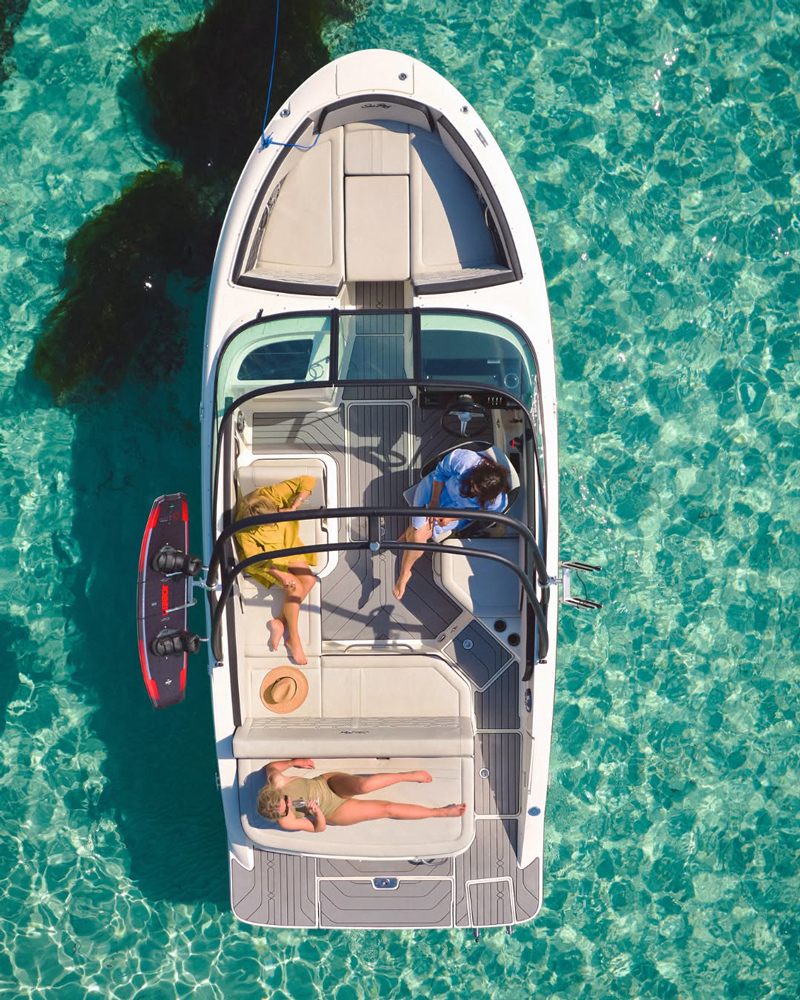
Jet skis and personal watercraft operate under dynamic physical conditions entirely different from standard recreational boats. PWCs frequently make rapid 180-degree hairpin turns, carve aggressively through heavy chop, and sustain constant prop-wash turbulence over the footwells and reboarding ladder swim platforms. Traction mats engineered for these applications require exacting Shore hardness tuning (typically 50–60 Shore C durometer) combined with tailored surface micro-grooving.
Our specialized CNC machining workflows utilize distinct texture profiles designed for specific performance categories:
For racing and aggressive wave carving, deep-embossed diamond textures combined with dual-directional CNC linear channeling direct pressurized water away from the rider’s contact points. This hydro-channeling principle mimics modern high-performance automotive rain tires, preventing aquaplaning beneath neoprene booties or bare feet and ensuring instant edge control during sudden throttle accelerations.
For cruising and recreational runabouts, brushed directional finishes offer a velvety, soft-touch interface that dissipates surface heat. Standard dark fiberglass decks in summer climates frequently surpass 65°C (149°F), presenting severe burn hazards to swimmers and pets. Specialized light-refractive closed-cell EVA formulas reduce surface temperatures by up to 25%, maintaining a safe, touch-friendly cockpit surface throughout peak midday solar irradiation.
A critical failure point in low-quality aftermarket jet ski mats is edge peeling caused by high-velocity water jet backwash. Premium marine EVA fabrication incorporates a 45-degree or 60-degree CNC beveled perimeter edge. This precision profile allows turbulent water to glide smoothly across the surface without snagging the pad borders, radically extending adhesive bonding lifespans in extreme aquatic conditions.
| Performance Parameter | Marine Closed-Cell EVA/PE | Traditional Teak Wood | Molded Gelcoat / Non-Skid | Standard Vulcanized Rubber |
|---|---|---|---|---|
| Wet Traction Coefficient (COF) | Superior (0.85 - 0.95 μ) | Moderate (0.55 μ) | Fair to Poor (0.35 μ) | Good (0.70 μ) |
| Water Absorption | 0.00% (Closed-Cell Hydrophobic) | High (Requires Sealing) | None (Impervious) | Minimal |
| Shock Absorption & Ergonomics | Exceptional (Elastic Cushioning) | Rigid (Zero Damping) | Extremely Hard | Moderate (Dense Mass) |
| Surface Thermal Retention | Low (Dissipative Formulation) | Moderate to High | Very High (Burns Bare Feet) | Extremely High (Dark Black) |
| Routine Maintenance Overhead | Near Zero (Mild Soap & Water) | Extensive (Oiling & Sanding) | Moderate (Acid Washing) | High (Prone to Chalking) |
| Customization & Logo Milling | Infinite 2D/3D CNC Designs | Restricted / Costly | Fixed Mold Tooling Required | Limited to Cast Molds |
Achieving seamless fitment across intricate jet ski footwells, rounded gunwales, and stepped swim decks requires an unbroken digital workflow. As an established OEM/ODM marine supplier, our manufacturing ecosystem bridges state-of-the-art 3D optical laser scanning, CAD parametric engineering, and multi-axis automated CNC routing tables.
1. Rapid 3D Digitization & Template Verification: Using portable coordinate measuring arms and structured-light optical scanners, we capture exact compound curvatures, scupper drain contours, inspection hatch cutouts, and fastener recesses with sub-millimeter precision. This eliminates the dimensional inaccuracies typical of manual paper tracing.
2. Dual-Layer & Multi-Color Thermo-Lamination: High-density EVA sheets are co-extruded and laminated under precise temperature and pressure thresholds. By milling through the 3mm top layer into a contrasting 3mm base layer (e.g., Brushed Black over Bimini Blue or Teak Brown over Snow White), intricate custom boat names, registration numbers, measurement rulers, and brand logos are rendered with ultra-crisp architectural lines.
3. Commercial ROI for Fleets and Dealerships: For commercial watercraft rental agencies, installing high-traction EVA decking directly mitigates customer slip-and-fall slip liability claims. Simultaneously, the durable foam protects costly gelcoat surfaces from anchor drops, scuba tank gouges, wakeboard fin strikes, and heavy foot traffic, substantially preserving the asset's resale value over a multi-year service lifecycle.
Discover our complete range of precision-engineered anti-slip flooring kits and custom marine pads.
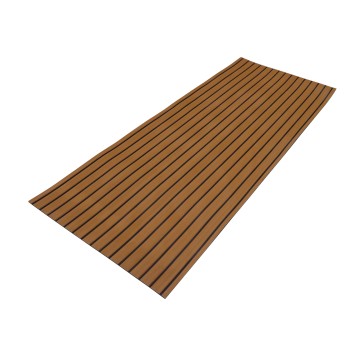
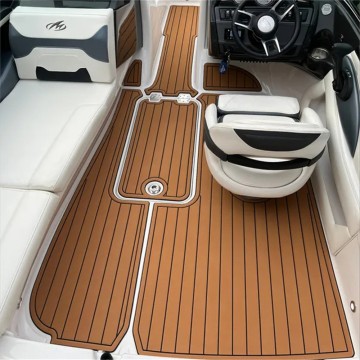
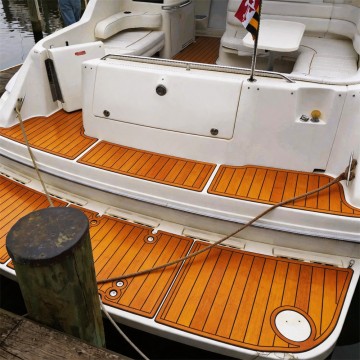
To guarantee decades of dependable service without edge lifting or adhesive failure in marine environments, adherence to structured installation protocols is paramount. Whether outfitting a single PWC or retrofitting a fleet of commercial charter yachts, the following standardized workflow ensures maximum bond strength:
Fiberglass gelcoats must be completely stripped of residual mold release waxes, sealants, and atmospheric pollutants. Thoroughly clean the mounting deck utilizing pure isopropyl alcohol (IPA) or acetone with lint-free microfiber towels. Inspect for surface irregularities and ensure the ambient working temperature remains between 18°C and 32°C (65°F – 90°F) during application to facilitate optimal pressure-sensitive adhesive cross-linking.
Position each CNC-milled mat dry across the target deck section. Secure the center point using marine masking tape to create a "hinge." Peel half of the adhesive backing paper from the center outward, carefully pressing the mat into position while working outward from the center to eliminate air pockets. Repeat the process for the opposite half, utilizing an engineered pressure roller (applying minimum 15 psi) to activate the pressure-sensitive acrylic micro-spheres.
Unlike traditional teak decks requiring toxic chemical acid washes and seasonal oiling, closed-cell PE/EVA marine flooring requires only mild biodegradable boat wash, warm freshwater, and a medium-stiff nylon bristle brush. For stubborn grease, fish blood, or fuel spills, all-purpose citrus cleaners or pressure washers (under 2000 psi at a 30-degree angle) remove contaminants instantly without marring the textured surface. Furthermore, our modern formulations are 100% recyclable, halogen-free, and REACH/RoHS compliant, ensuring zero toxic leaching into sensitive marine and freshwater ecosystems.