- Home
- Products
- About Us
- Application
- Custom
- News
- Contact Us
Leave Your Message
-
Contact Email
Discover our flagship marine-grade and mobile-living floor pads built with high-density EVA composite matrix, delivering superior tear resistance and watertight sealing.
How closed-cell synthetic marine decking transitioned into the premier choice for Class A, Class B camper vans, toy haulers, and high-end overlanding vehicles.
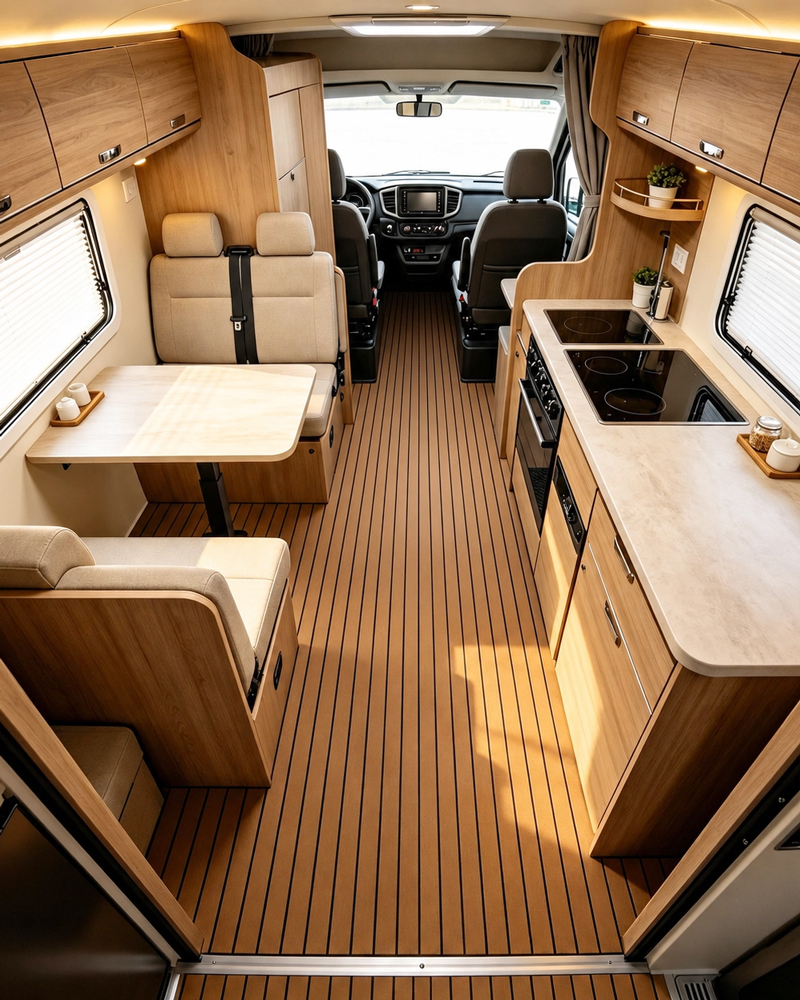
Marine faux teak was originally designed to withstand saltwater spray, extreme solar ultraviolet degradation, and constant mechanical abrasion. When transplanted to recreational vehicles and camper conversions, it solves persistent issues of subfloor water rotting, linoleum peeling, and high-moisture condensation that traditional RV materials fail to counter.
With mobile living environments demanding higher climate control efficiency, closed-cell EVA/PE copolymers deliver low thermal conductivity (≤0.038 W/m·K). This structural barrier prevents road cold transfer through chassis metal while reducing high-frequency engine and suspension vibration up to 12 dB.
Strict Gross Vehicle Weight Rating (GVWR) limits in expedition rigs and camper vans necessitate ultra-low mass materials. At merely 1.4 to 1.9 kg/m², faux teak EVA foam saves up to 68% total floor weight compared to luxury vinyl tiles (LVT), engineered hardwoods, or natural teak planks, substantially preserving fuel economy.
In the contemporary landscape of mobile living and off-road overlanding, vehicle floor protection is subjected to continuous micro-stressors: fluctuating thermal gradients, dynamic chassis twisting, mud abrasion, chemical solvent spills, and pet claw wear. Traditional vehicle flooring substrates—such as standard polyvinyl chloride (PVC) sheets, needle-punched carpets, and laminate composites—often degrade when exposed to outdoor dirt, condensation traps, and frequent wash-downs.
By leveraging modified ethylene-vinyl acetate (EVA) and cross-linked polyethylene (PE) high-density formulations, faux teak boat flooring for RV and camper floor protection establishes a non-porous, shock-absorbing, and self-draining floor architecture. Its micro-cellular structure is completely hermetic, meaning zero absorption of stagnant water, pet waste, or spilled cooking oils, eliminating bacterial colonization and interior mildew odors common in adventure vans.
Engineered with micro-textured brushed finishes and precision-beveled CNC grooving, faux teak decking guarantees an anti-skid coefficient of friction exceeding 0.75 across dry, mud-slicked, or wet surfaces. Whether stepping inside after a rainy hike or showering in an integrated wet bath, slip-and-fall hazards are systematically neutralized.
Formulated with advanced Hindered Amine Light Stabilizers (HALS) and anti-aging antioxidants, high-tier EVA boat flooring resists color fading, chalking, embrittlement, and surface contraction even when deployed in exterior open-air slide-outs, fold-down camper ramps, and exterior under-awning transition decks.
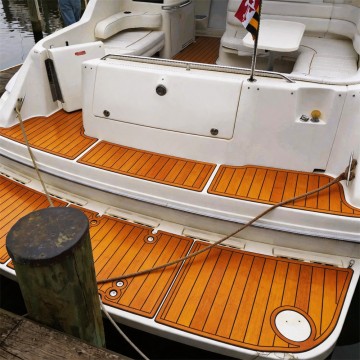
The versatility of synthetic faux teak allows OEM coachbuilders, custom van upfitters, and aftermarket enthusiasts to install custom-cut profiles across diverse interior and exterior functional zones:
The table below summarizes the physical, operational, and lifecycle parameters of synthetic marine faux teak compared with alternative floor surfacing technologies employed in the RV and overland sector:
| Performance Metric | Marine EVA Faux Teak | Standard RV Linoleum / PVC | Luxury Vinyl Tile (LVT) | Natural Hardwood / Real Teak |
|---|---|---|---|---|
| Density & Weight / m² | 1.4 – 1.8 kg (Ultra-Light) | 2.8 – 3.6 kg (Medium) | 4.5 – 6.2 kg (Heavy) | 8.5 – 12.0 kg (Extremely Heavy) |
| Water Absorption Rate | 0.00% (Closed-Cell Hermetic) | < 0.5% (Seam Vulnerable) | < 0.2% (Interlock Leaks) | 8% – 15% (Requires Oiling) |
| Acoustic & Road Noise Damping | Superior (-10 to -14 dB) | Negligible (< -2 dB) | Minimal (-3 dB) | Low (Prone to Resonant Creaks) |
| Thermal Insulation (λ) | 0.034 – 0.038 W/m·K | 0.17 – 0.22 W/m·K | 0.20 – 0.25 W/m·K | 0.13 – 0.18 W/m·K |
| Wet Traction Safety (COF) | > 0.78 (Non-Skid Brushed) | 0.35 – 0.45 (Extremely Slippery) | 0.40 – 0.50 (Moderate Slip) | 0.55 – 0.65 (Medium Grip) |
| Installation Methodology | Peel-and-Stick (3M Acrylic PSA) | Full Chemical Wet Glue | Click-Lock Floating / Glue | Screws, Caulking & Bedding |

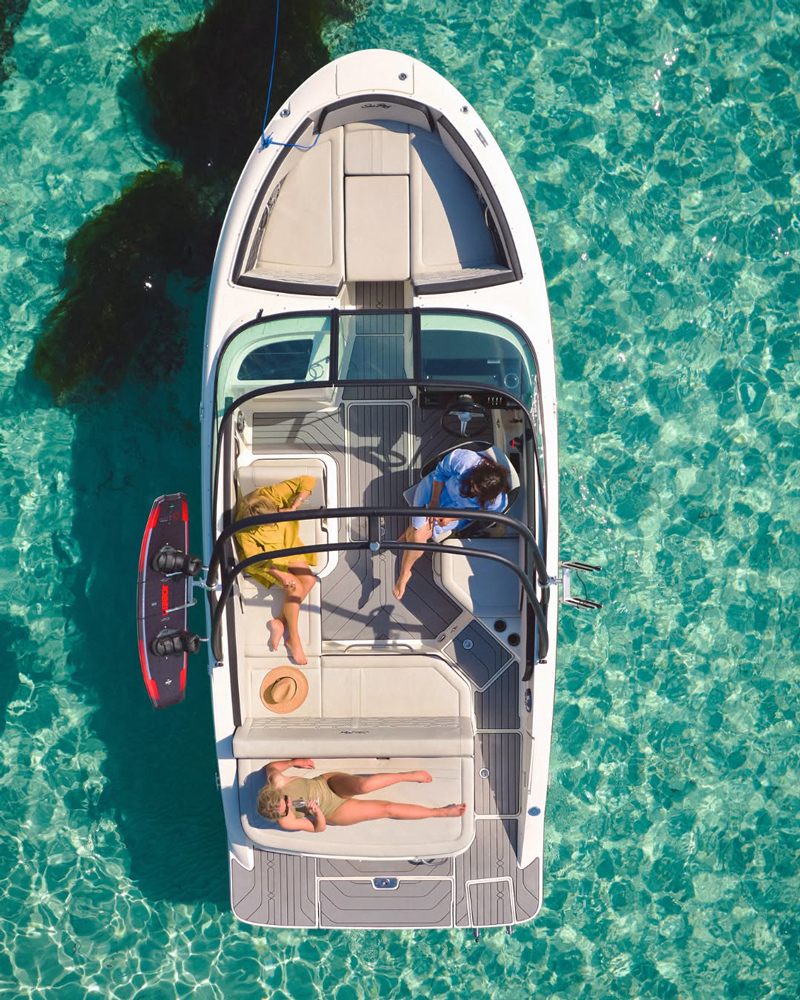
From heavy-duty overland vehicles to luxury marine yachts, explore our comprehensive range of specialized EVA foam protective decking solutions.

From high-speed multi-axis CNC routing to proprietary pressure-sensitive adhesives, we deliver scalable turnkey manufacturing tailored to vehicle body blueprints.
We ingest exact 2D DXF and 3D STEP vehicle chassis blueprints to route complex floor geometries, seamless wheel arch clearances, table pedestal cutouts, and wire chase channels with tight ±0.5mm industrial machining tolerances.
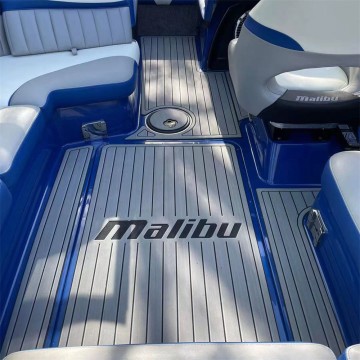
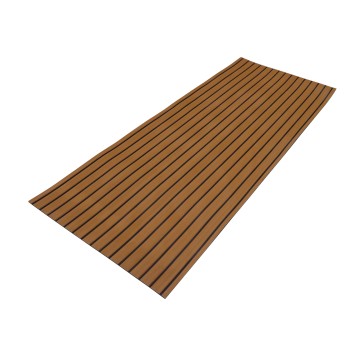
Featuring 2-tone laminated sheets (e.g., Teak brown over Black, Storm grey over White, Espresso over Midnight), precision CNC v-grooving exposes the contrast sub-layer for a clean, permanent faux teak plank aesthetic without separate joints.
Factory-pre-applied with authentic 3M 9775WL or 99786 high-tack acrylic pressure-sensitive transfer tapes engineered specifically for Low Surface Energy (LSE) substrates, guaranteeing zero edge curling under high-cabin temperatures.
Achieving a permanent bond and maximizing the longevity of faux teak boat flooring in recreational vehicles requires adhering to standard industrial surface preparation and maintenance procedures:
Ensure the vehicle subfloor (whether raw aluminum, marine plywood, painted fiberglass, or smooth steel) is degreased using a 50:50 Isopropyl Alcohol (IPA) and distilled water solution. The surface must be completely dry, dust-free, and oil-free. Installation should ideally be conducted at ambient temperatures between 18°C and 30°C (65°F – 86°F) to ensure optimal initial adhesive wet-out.
Once aligned, peel back the backing film incrementally while applying uniform mechanical pressure with a weighted silicone hand roller (minimum 15 psi). This activates the pressure-sensitive acrylic micro-spheres. Full adhesive cross-linking occurs within 24 to 72 hours, during which moisture exposure should be avoided.
Thanks to the inert closed-cell structure of EVA/PE copolymers, maintenance requires no specialized oils, varnishes, or buffing machines. Normal cleaning is achieved using pH-neutral automotive car soap, warm water, and a medium-stiff nylon bristle brush. For stubborn camp grease or food drippings, mild household citrus-based degreasers can be used safely without degrading material elasticity.
Premium precision-machined floor kits engineered for all marine hulls, overland campers, custom vans, and recreational equipment.